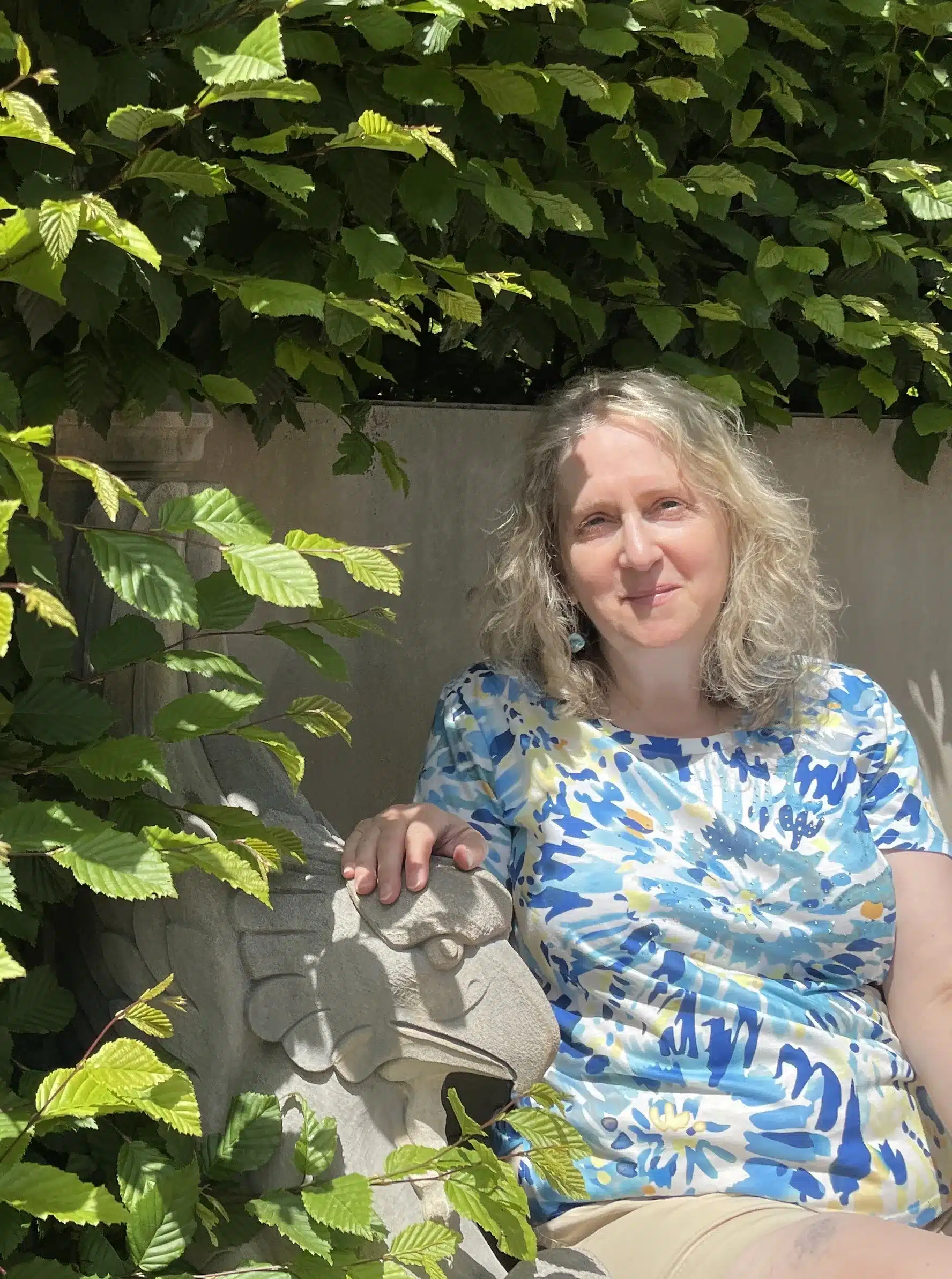

Carole Bernstein is the author of two poetry collections from Hanging Loose Press: Buried Alive: A To-Do List, and Familiar, which J. D. McClatchy called “an exhilarating book.” She is also the author of And Stepped Away From the Circle (Sow’s Ear Press), winner of the Sow’s Ear Chapbook Competition. Her poems have been widely published in magazines such as Antioch Review, Apiary, Bridges, Button Jar, Chelsea, Hanging Loose, Light, Paterson Literary Review, Poetica, Poetry, Shenandoah, The F-Word, The Ledge, and Yale Review. She has been included in anthologies including American Poetry: The Next Generation (Carnegie Mellon University Press), The Laurel Hill Poetry Anthology: 175 Years of Reflection (Laurel Hill), Moms on Poetry (momsonpoetry.com), Poetry Ink and The Weight of Motherhood (both Moonstone Press), and Unsettling America (Viking). Work is forthcoming in Amethyst Review, Rat’s Ass Review, and the anthology Keystone: Contemporary Poets on Pennsylvania (Penn State University Press). Born and raised in Brooklyn, Bernstein lives in Philadelphia with her husband, the writer and magazine editor John Prendergast, and works as a freelance promotional writer and marketing consultant. She is one of the founding members of Suppose an Eyes, one of Philadelphia’s longest-running poetry workshops. Bernstein holds an M.A. from the Johns Hopkins Writing Seminars and a B.A. in English from the University of Pennsylvania.
Hanging Loose Press: What are this past year’s accomplishments that you are most proud of?
Carole Bernstein: I have to start by saying I feel honored to be in the company of the accomplished, talented poets you’ve featured in Catching Up so far!
This past year I’ve had poems included in two anthologies from Moonstone Press: The Weight of Motherhood and Poetry Ink. For these publications I got to participate in live readings at the University of Pennsylvania as well as virtual ones. The motherhood anthology was amazing—such a variety of experiences, running the gamut of human emotions—the good, the bad, and the ugly. My own poem, “Never,” dealt with the experience of infertility, which my husband and I grappled with for five years before having my older daughter.
I had a poem accepted to Rat’s Ass Review (piquant title, I know!): “Anthem for Captain Kirk,” which will appear in the Spring 2024 website, e-book, and print issue. My poem “A Baby Picture” will appear in May in Amethyst Review. And my poem “Quaker Memorial Service for a Young Girl, Germantown” was accepted to the anthology Keystone: Contemporary Poets on Pennsylvania, due out from Penn State University Press next year.
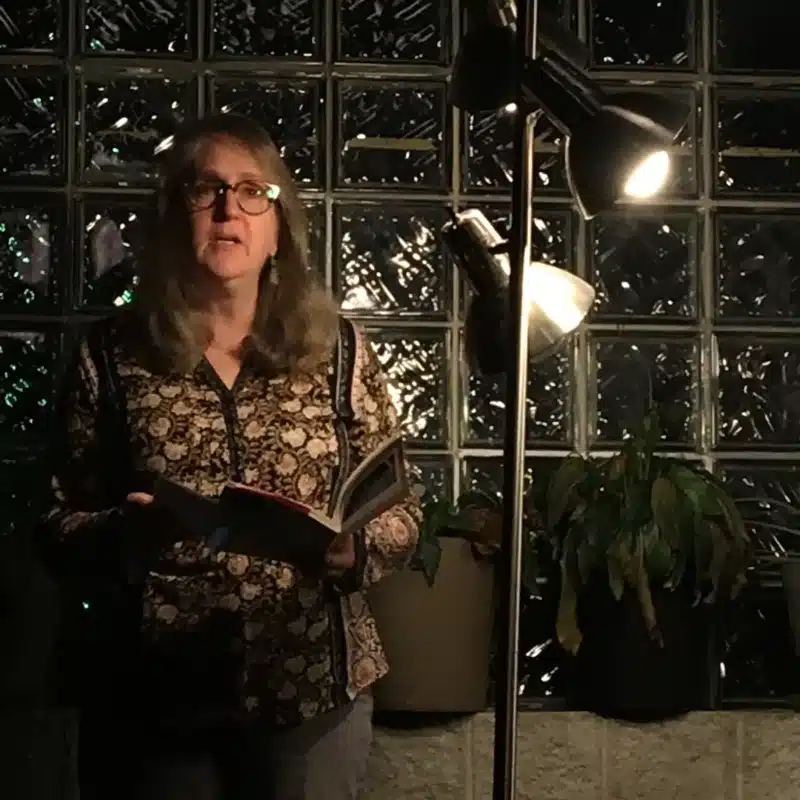
My poetry group Suppose an Eyes, of which I’m a founding 20-year member, performed at Kelly Writers House at the University of Pennsylvania in January.
Hanging Loose published three of my poems in HL #112: “Cat Prepares to Drink From Toilet,” “Sky Bar,” and “Sleepaway.” I just checked the publication date and it was actually 2022, but I wanted to sneak that in there because I was so happy about it! I think “Sky Bar” is one of my best poems. It was based on a startlingly vivid dream: I was in midtown Manhattan with my long-dead mother and I found a yet-to-be-invented kind of candy bar at an old newsstand. Then I thrillingly got lost in the crowd. The last line of the poem is the sort that every poetry workshop tells you to take out—I thought about it a lot but was glad I kept it.
HLP: Dreams are so much like talismans. “Sky Bar” appears to offer up the kind of detail and knowingness that can only come from an unfettered psyche.
CB: I want to mention how important Hanging Loose has been in my life. When I was in high school my aunt saw an article about HL in the New York Times that mentioned the High School Writers section. I submitted and had several poems accepted. It was an astonishingly wonderful experience, and a huge jump from the school literary magazine to professional publication. I couldn’t believe that my poems had made sense and meaning to a group of adult editors, who didn’t know me and had no reason to accept my work other than they thought it was good. That I had communicated with them, and with the magazine’s readers, through poetry—the form in which I was driven to communicate.
Over the years I’ve had a number of other poems published in HL, and eventually two books with Hanging Loose Press, thanks to the late and much-missed Bob Hershon. My first one, Familiar, came out in 1997 when I was also (finally) expecting my first child. I was in a reading with other HL authors while seven months pregnant. I still remember the bright red maternity top with little silver buttons I wore. It was one of the best moments of my life.
HLP: I love that you are a Hanging Loose High School Poet! Your connection to the press is so appreciated and it is because of writers like you that we are so vibrant and hopeful. And in Bob’s memory, stubbornly pushing through six decades.
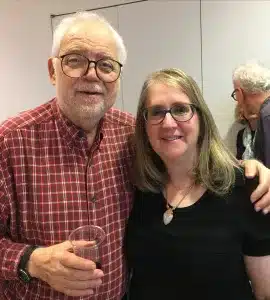
HLP: 20 years in a poetry group sounds like quite the feat. Can you describe for us a little bit of how your group operates?
CB: Suppose an Eyes’ survival is partly due to the University of Pennsylvania’s generosity, for letting us meet in the beautiful old campus building known as Kelly Writers House. Penn has also permitted the group to be open to the general community as well as students. But the main reason it’s survived is its self-styled group leader, Pat Green, who has been the driving force for all this time–doing the boring administrative work, reminding people to come to meetings, scheduling readings for us. (She is a great poet in her own right.) There have been group members–including myself–who have all but disappeared for a year or two and returned, with the same reaction: “Wow, it’s still going on!”
HLP: Any particularly difficult experiences/challenges for you this past or current year? And how did you work through them?
CB: My main challenge has been my feet. (My poetic feet have been fine; it’s my actual feet that are the problem.) I’ve had plantar fasciitis since high school and have had to wear custom-made orthotics and mostly sneakers my whole life. That has mostly gone okay—except for feeling ridiculous at formal occasions—but during the pandemic I did a ton of walking (gettin’ that fresh air!) and developed additional issues. Now the last several times I’ve taken even a short trip—to the beach, or to New York, my hometown (I live in Philadelphia now)—I end up with something: a tendon strain, a stress fracture. We were scheduled to go to Rome last Fall to visit my daughter who’s studying abroad, and had to cancel the trip. I have a nagging dread that I will end up not being able to walk much at all, sooner rather than later. Hiking, cooking a complicated dinner, or even stepping out for a short mind-clearing walk, are no longer always possible for me. And considering that I’m in excellent health otherwise, the last thing I want as a woman in my early 60s—increasingly conscious of aging and appearance—is to be seen using a cane or wheelchair. All is vanity.
Being incapacitated from time to time has given me a little taste of what people with disabilities must go through (although I wouldn’t claim to truly understand their life experience.) People treat me differently when I’m being pushed by my husband in a wheelchair than when I’m walking at his side. And I’m at eye level with everyone’s crotch instead of their face. I’ve also become more aware of challenges to accessibility: miles of cracked and pitted sidewalks; bumpy cobblestones; curb cuts blocked by parked cars; poetry readings and theater performances you can only get to via narrow stairways; even a museum exhibit where I couldn’t really see the photographs because, looking up from a wheelchair, there was too much glare on the glass.
At a holiday party at a friend’s house recently, where I had walked in with a cane, and where the hors d’oeuvres were perfectly within my reach, some guests kept insisting on bringing me food without asking me. One woman even remarked that my “husband was right there,” implying he should jump up to assist me. The experience reminded me of Gloria Steinem’s anecdote about a college geology field trip, during which she found a snapping turtle at the side of the road and “helpfully” hauled the heavy creature back to the river. Her professor hurried over, too late, and told her the turtle had probably made its way out of the river to lay its eggs in the mud. It would take it about a month to get back. “Always ask the turtle,” said Steinem. Good advice.

HLP: Very good advice. Speaking of advice, what are three books you’ve read recently that have made an impression on you?
CB: First and second books: Emily Dickinson’s Selected Poems and Sharon Olds’ poetry collection Arias. I brought both to a scary medical scan recently, and since the scanner was only over my legs, the kind tech let me hold a book and keep the other one near my head. The fact that I grabbed these two titles off my bookshelf for distraction and comfort says volumes (haha) about how much they mean to me. (The Emily Dickinson book was from 1960—Dell Publishing, 35 cents—and when I dogeared a particularly good poem, the corner of the page fell off.) I loved having something old and wonderful with me in such an impersonal, sterile-feeling environment.
Sharon Olds has always been an inspiration to me as a woman poet. What I get from her—besides pure enjoyment of her art—is, “Yes, yes, you can write about these intimate female things! And don’t let anyone tell you they are not ‘universal.’”
Third book: Middlemarch by George Eliot, which I am slowly making my way through now, savoring every phrase. I love Victorian novels, having been an English major. I’m always amazed at how long descriptions of the minutiae of life can be made totally engrossing in the hands of a brilliant writer.
HLP: Ah, books are the real medicine! Some of your new poems deal with some painfully awkward moments so I especially appreciate your saying that intimate female things can be universal. Can you describe your process of knowing/choosing how much of the underbelly to expose?
CB: I would answer that question with a favorite quote from the writer Anne Lamott: “You own everything that happened to you. Tell your stories. If people wanted you to write warmly about them, they should have behaved better.”
HLP: Any upcoming projects?
CB: I am putting together a new manuscript. I have a number of poems written during the pandemic that were very intense and I think very successful. I feel that in addition to having more time—because of staying home a lot, as we all did—I had a heightened level of concentration, and some strange thoughts, fears, and dreams that led to decent writing. (And many that did not, of course!)