

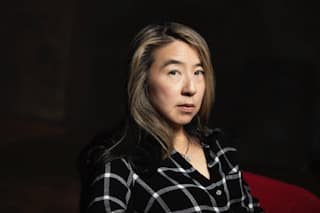
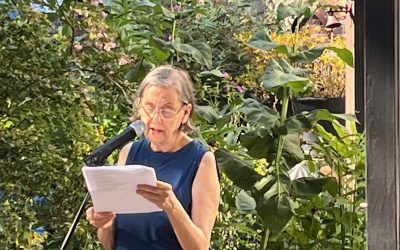
Jiwon Choi is a poet who struggles to identify and name emotions that remain unnamed and unrevealed from childhood experiences and traumas in order to become the fully actualized human she knows she can be. Choi is the author of One Daughter is Worth Ten Sons and I Used To Be Korean and her third poetry collection, A Temporary Dwelling, will be coming out from Spuyten Duyvil this June. She started her community garden’s first poetry reading series, Poets Read in the Garden, to support local writers during the early Covid years. You can find out more about her at iusedtobekorean.com.
Hanging Loose Press: What are this past year’s accomplishments that you are most proud of?
Jiwon Choi: The impulse to list accomplishments recognizable to the publishing world (and beyond) gives me an acid reflux sort of sensation. I feel it is linked somehow to the compulsion to constantly compare oneself to others, what a sad human condition. I am sure this is something we pick up from our grownups who in turn learned it from theirs and whatever dominant culture around them. This is a little bit of what Bob Hershon named “careerism” and something I don’t really want to be involved in, but am. Is there a way to identify accomplishments as more intimate and personal, like whether you were able to make amends with yourself, allow yourself some grace for something you did in the past that you’re not so proud of?
Okay, with all of that being said, I was able to get my third book of poems published this year, officially coming out this month from Spuyten Duyvil. It takes a while to get a book out of the manuscript phase, and not that when I’m writing poems am I necessarily contriving for it to be in a book, but the poems in this third one felt like a collection from early on.
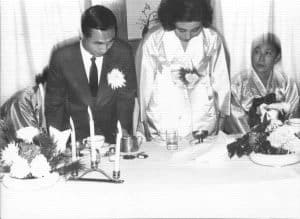
And I got married this past May to my love, Matt Beckerman, with whom I’ve been with for 17 years, which makes me feel a little bit more like a grown-up as opposed to the perpetual twelve year old I am in my head.

HLP: Congrats on your new book and getting married! But the “careerism” idea sounds like ambition, no?
JC: I think my takeaway from talking with Bob, is that you can have much passion about your writing life, but if it clouds your judgement on how to be in the poets community, then you are losing your focus on the point of making poetry.
HLP: Any particularly difficult experiences/challenges for you this past or current year? And how did you work through them?
JC: I am still reeling from the death of my mother (from Covid) and aunt (probably from sepsis) in 2020. I know I haven’t fully released them from this world, but I don’t know how. Or I don’t know if there is such a thing. I think I am just going to have to be haunted by my family spirits for as long as I live. As an only child and lone survivor of my nuclear family, this will have to do.
HLP: When you say “haunted” can you expand on that a bit more?
JC: I have been visited by my father, mother and aunt in my dreams since their respective deaths. The dreams are often uncomfortable, but they offer me some sort of odd comfort. This is the only source of contact I have with them so I am open to becoming a vector of past and future.
HLP: Can you give us three books you’ve read recently that have made an impression on you?
Haunting the Korean Diaspora by Grace M. Cho
Grace Cho’s book on the intergenerational trauma Koreans in the diaspora encounter as an aftermath of the Korean War, is proving to be invaluable to me as I work on my next book. Ironic but I have purposely avoided books like this in the past, knowing that I wasn’t emotionally ready to receive its historically brutal honesty. Pak’s Korean American Women, another text dealing with identity in the diaspora of note, feels more clinical so is a less threatening read.
Jazz Is by Nat Hentoff
This is the third time I am reading Jazz Is. A primer for the ages, and I cry every time I read the chapter on Charlie Parker.
My Trade is Mystery by Carl Phillips
I have learned so much from Phillips: “I don’t want instruction––didn’t want it when I started, either; I want companionship, a partner in speculation, a reminder in my alonest moments that I’m not alone entirely. I want intimacy, I adore economy, I require precison.”
HLP: Any upcoming projects?
JC: Book four will be a hybrid collection of poems and essays based on Grace M. Cho’s Haunting the Korean Diaspora. I am also contemplating a Barbie diorama project.
HLP: Is the Barbie project a real thing?
JC: In my mind, yes.
Check out Jiwon Choi’s website:https://www.iusedtobekorean.com/

 From loose pages to issue 119 of our magazine, an anthology of over 100 HLP poets, over a decade of the Loose Award for translated works, the Founders prize for first book in its third year, and a bunch of great books in the works, we couldn’t have come this far without you.