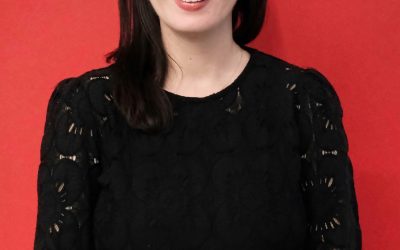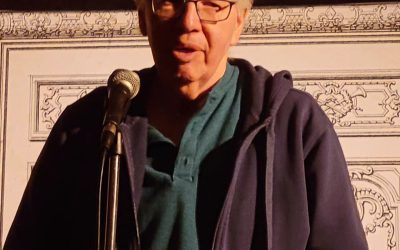

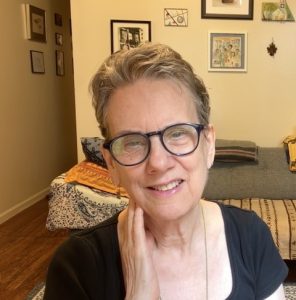
Barbara Henning is the author of six novels and eight collections of poetry. Most recently, Ferne, a Detroit Story (Notable Book Award from the Library of Michigan, published 2022); a poetry collection, Digigram (2020); and Poets on the Road (with Maureen Owen, 2023). She has taught for Naropa University and Long Island University. A native Detroiter, she lives in Brooklyn and teaches for Writers.com. www.barbarahenning.com.
HLP is happy to publish Barbara Henning’s singularly expert Girlfriend, a collection of poetic prose, stories about the girls and women who were important in Henning’s life, beginning in childhood through her older years, including mentors, characters and authors whose writing was important to her. The collection of stories is a celebration of her friendships with women, highlighting a working-class girl who loses her mother as an adolescent, to become a mother herself, as well as a poet, a novelist and a professor. In Henning’s friendship world ––the bohemian communities in Detroit and New York City––one meets artists, poets, fiction writers, literary critics, activists, mothers, yoga practitioners and teachers, among many others.
Hanging Loose Press: Is there a poem or poetry collection that has meant a lot to you? How has your relationship to it evolved over time?
Barbara Henning: When I first read H.D.’s Trilogy in 1980 or ‘81, I was not in love with it. I wasn’t attracted to her use of religious and mythic figures, but I liked the images in her writing and the way she responded to the war in her poems. I was a feminist of my age and time and very sensitive to class issues and wanting to prove that we could do what men could do so we deserved equal recognition. At first when I read HD, I didn’t recognize how her feminine characters and transformations were in fact feminist. I wrote a paper in grad school on Trilogy, and I came back to the book again while teaching modernist women poets at Long Island University. Recently when writing a piece about H.D. for my new book, Girlfriend, I reread Trilogy several times and held a reading group in my apartment. I have come to love this book, love the way her images and figures slide and transform; the entire book is an alchemy, and she proposes alchemy as a way poets do their work in the world, the way we work with sound, meaning and the imagination to change consciousness (we are voyagers, discoverers/of the non-known). Later I realized that her images had in fact become part of my dream world.
There are so many writers and books of poetry that have been important to me, but William Carlos Williams has been very influential on my writing. I liked that he had a job in the world. He was a doctor, he had a family, and he wrote about his patients and his life as a doctor in Paterson, New Jersey. He wrote about desire and beauty. I was first introduced to his poetry when I was an undergraduate, and we read a handout of his poems and a collection of his stories. I was especially drawn to the poems. I liked the way he wrote about ordinary people and things, in what he called the American idiom, as opposed to the language of European poetry. I was drawn to the way he saw beauty in what was often overlooked– “Between Walls”//the back wings/of the//hospital where/nothing//will grow lie/cinders/in which shine/the broken//pieces of a green/bottle”. Like H.D’s alchemy, in his poems, Williams changed a seemingly insignificant object into something meaningful, maybe even spiritual. The work of Williams that became most important to me were his improvisations and his experiments with poetry and prose. Some of my favorite poems are “Spring and All,” “The Descent of Winter” and Paterson.
HLP: Would you say you bring Williams’ idea of the “American idiom” into Girlfriend and/or your other writing projects?
BH: Williams was talking about engaging the rhythms and language of everyday American life. In my poetry I often write about various people I encounter on the subways and streets of NYC. The narrative voice in Girlfriend (my voice) is intimate and conversational as I remember the friend I am addressing. Yes, I think all of my creative work is in an American idiom, or in one or more of the American idiom(s).
HLP: What are this past year’s accomplishments you are most proud of?
BH: I was very happy to finish writing Girlfriend and then Hanging Loose published the book this year. And the book itself is very beautifully designed. I worked on this collection for about four years, but I didn’t work on it alone. Several of the women I was writing about shared their ideas, I was in two poetry workshops, and then there was also the group of editors at Hanging Loose. A lot of people helped make this book happen.
HLP: What do you find are your greatest challenges when writing? Do you have a method or thought process for overcoming them?
BH: My greatest challenge with writing is to have time to write. When I have time, I have no trouble writing. I’m still teaching and as I get older, I need more time to finish a piece, and I need to have a clear mind that isn’t always thinking about something else I must do. I am trying to figure a way out of this quandary. I still need to make money to live in New York so I must teach, but perhaps I can teach less. Or I can stop adding new projects and meetings. Or perhaps at this late stage in life, I should concentrate on learning how to meditate better and create a clearer space for writing and thinking. Perhaps this tension about time and money is why I was continually concerned about whether I could actually finish Girlfriend in time to start another project. Now the same thing is happening with “Boys and Men.”
HLP: What helps you choose to keep writing even when you’re worried you may not finish or be able to start projects you’ve shelved?
BH: Besides having other obligations, I’m concerned about having enough time left in my life. It’s taking me longer to write chapters in “Boys and Men” than it did with Girlfriend. But what else is there to do? Keep writing and hope for a new project.
HLP: What inspires you to write?
BH: I like working on projects. For example, with Ferne: A Detroit Story, I started out scanning a set of photo albums that documented my mother’s life. Then I decided to write about the photos, and then I decided I couldn’t write about my mother’s life unless I knew the context better. She died when I was eleven, so I only knew her as a child. In order to understand her life, I started researching the history of Detroit during her lifetime. One thing led to another. A group of poems became a collage became a 300 page hybrid text with photos and clipping and a novelized story.
Another example – For years I kept daily journals on different types of paper and notebooks,. ] I would experiment with the way I was writing the journal—writing on every other page, a word from one page inspiring the next, etc. Then when one journal was finished, I would extract text and do various experiments. Maybe I was writing a series of poems or in one case, a novel.
When I had the idea to write about all my girlfriends, that was also a project, a memory project. I wasn’t just telling a story; these pieces are more like prose poems with a collage thought pattern. I wrote about each of my girlfriends, then mentors and teachers, then characters and authors who were meaningful in my life. The project got larger and longer as I went along. And this project inspired the next project, the one I’m working on now, “Boys and Men.” So you see—there’s no need to worry about inspiration. The possibilities for writing are endless when you invent projects.

HLP: Do you have any hobbies or other passions that influence what you write or how you think about writing?
BH: For the past thirty years, I have been an avid yoga practitioner. What I’ve learned from yoga, that has helped me as a writer, is that you do it every day. I wake up in the morning, shower and do my yoga practice, and then I eat breakfast and begin to write. If I must teach, I work that into the day, along with writing. For me I don’t have an actual schedule for writing, I work on it all day long, in between other tasks.
HLP: What does your writing process look like? Are you more of a pantser or a plotter?
BH: Do I mostly plan or improvise? Structure and imagination are both important. I imagine a poem, a series of poems or a novel, and then I invent, improvise, drift, step back and revise and rethink, but I continue to work on the project or poem, allowing it to transform as I go along. This is true for me whether I’m writing a short poem or a novel.
HLP: Is there a difference in the possibilities of transformation within a novel versus a poem for you?
BH: Well with my novels, I’m usually covering a lot more territory in terms the plot and character development. Most of my novels are written in the first person. I like first person point of view because I can go almost anywhere—off into a reverie, a story, thinking, imagining—lots of room for improvisation. Even though I may have a plan, I can deviate from it. In Just Like That, I revealed the end in the beginning; the driving purpose was to allow the narrator to tell her story, and to better understand why she did what she did. With poetry, I’m constantly tinkering with every phrase. Yet, I am also trying to learn/discover something through the process of writing the poem.
Find more information about Barbara’s books and workshops at: barbarahenning.com
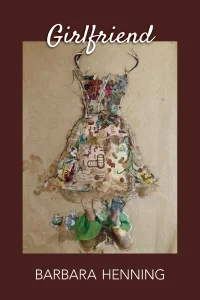
Order copies of Girlfriend here
Thanks to Olivia North-Crotty for assistance on this interview.