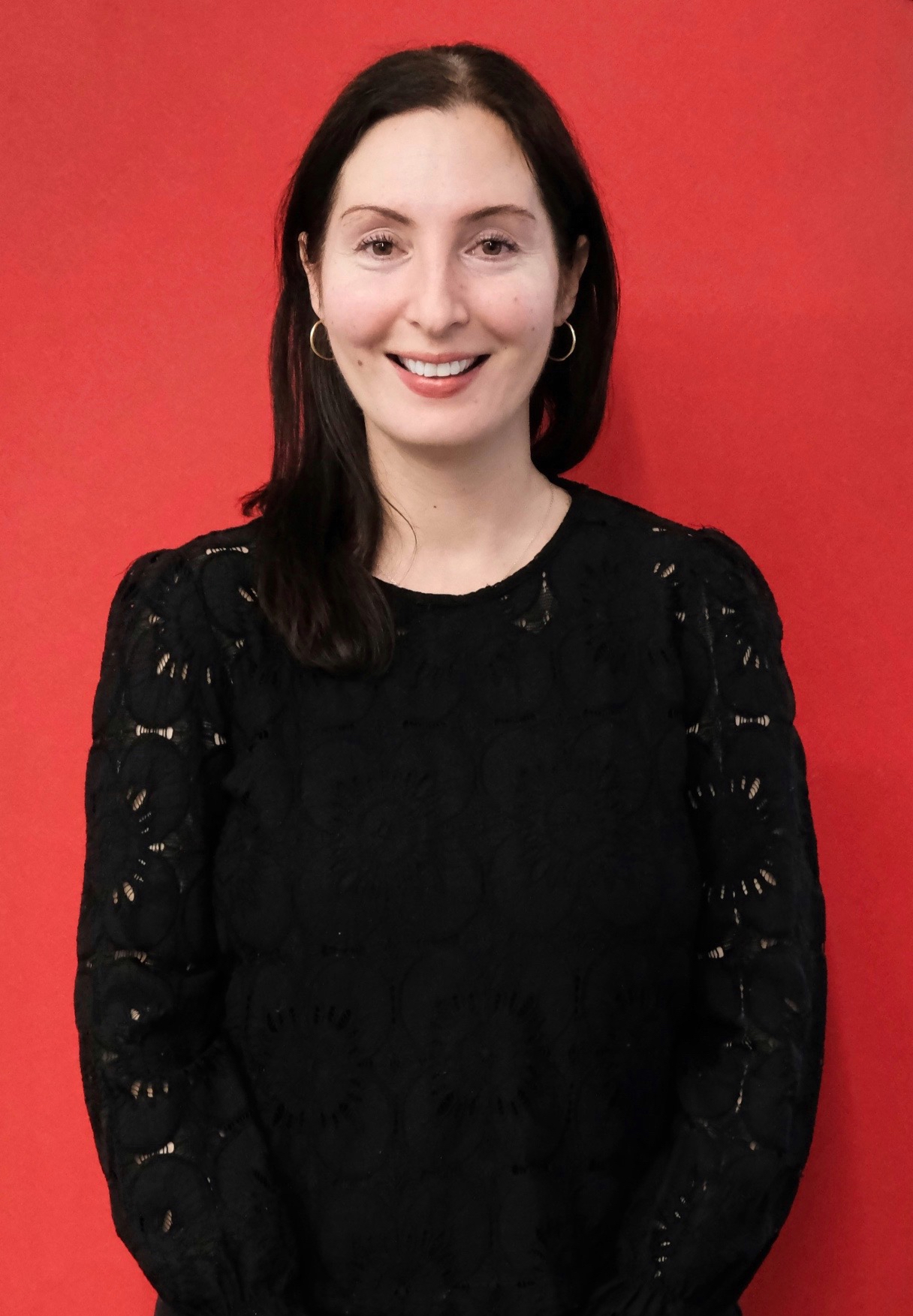
Caroline Hagood is an Assistant Professor of Literature, Writing and Publishing, Director of Undergraduate Writing at St. Francis College in Brooklyn. She is the author of three poetry books, Lunatic Speaks, Making Maxine’s Baby, and Death and Other Speculative Fictions; the essay collections, Ways of Looking at a Woman and Weird Girls: Writing the Art Monster; and the novels, Ghosts of America and Filthy Creation. Her speculative memoir, Goblin Mode, will be published by Santa Fe Writers Project in Fall 2025. Her work has appeared in publications including Electric Literature, Creative Nonfiction, LitHub, the Kenyon Review, the Huffington Post, the Guardian, Salon, and

Hanging Loose Press: What are this past year’s accomplishments that you are most proud of?
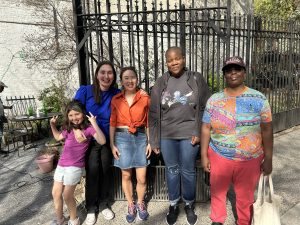
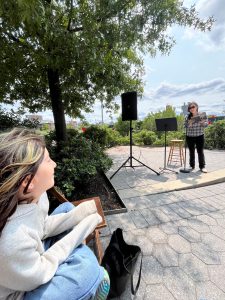
Caroline Hagood: At this point, there are so many profound things wrong in our world that I’m proud of putting one foot in front of the other and trying to advocate for change wherever I can. One of the things I keep repeating in order to get through this time is that one of my central projects is promoting the work of young and emerging writers. So, a high point of this year was when you and I did a Hanging Loose Press event at the Brooklyn Public Library for Issue 116 and invited my St. Francis College students to read with us. I think it meant a lot to them as well. All we can do right now is focus on the good we are able to do.
HLP: I know first hand that young writers need encouragement and your work with your students is so crucial. Can you give us some ideas on your strategies and commitment on how you support and promote the work of your young writers?
CH: Absolutely. Since I’ve been at St. Francis College, I’ve worked on several projects to feature the creative writing of our students. I created the SFC Writers Group, which was a Mighty Networks-based online community where faculty, administration, and students could come together to participate in meaningful ways. For instance, one time we completed an Exquisite Corpse style pass-the-story project there together with faculty, staff, and students that was really touching to see come together.
I also created our undergraduate publication, The Terrier Literary Magazine, with a terrific student, Anna Riddo, as Editor. In my Intro to Digital Publishing class, students work as staff on this magazine, which gives them some great hands-on experience.
Then the rest of it is really just trying to set things up for people and making myself available. When I give talks at other colleges, for example, I give students my email and encourage them to reach out with further publishing questions. I also try to set up readings for my students—as you know since you’ve been my favorite accomplice in this. And I know you and I both love how Hanging Loose Press has a special section in its magazine for the work of high school writers.
HLP: The High School Years can be so brutal, so yes, anything to provide encouragment is so important. Any particularly difficult experiences/challenges for you this year? And how did you work through them?
CH: This past year has been difficult for everybody in terms of various sociopolitical issues across the board. Since I work as an editor here at Hanging Loose Press and as a professor at St. Francis College, I can say the way that publishing and academia have struggled lately in terms of the new administration is astounding. We will all continue to fight. At Hanging Loose Press, for instance, in the face of book bans and so forth, we are here to promote marginalized voices to the end.
HLP: So much work to do to resist the onslaught of avarice and malice towards the most vulnerable of our society, and our democracy in general. What are three books you’ve read recently that have made an impression on you?
CH: I wish I could keep it to three. I’ll try not to go overboard. Books that have bowled me over recently that are currently on my nightstand: Choose This Now by Nicole Haroutunian, Data Mind by Joanna Fuhrman, Exploding Head by Cynthia Marie Hoffman, A Temporary Dwelling by Jiwon Choi (if I may, haha), The Familiar by Sarah Kain Gutowski, Craft by Ananda Lima, Why Alanis Morissette Matters by Megan Volpert, Human/Animal by Amie Souza Reilly, Saint Of by Lisa Marie Basile, La Del Amor by Gerald Fleming, and the amazing translation I’m editing right now for Hanging Loose Press: The Witness of Nina Mvungi and Other Stories, translated from the Swahili by Jay Boss Rubin.
HLP: And good that you brought up your role as Translation Editor for HLP. You’ve been doing that for some time now. How did you find yourself in this role and what appeals to you about this role?
CH: I found myself in this role when Co-Editor Bob Hershon asked me to take it on. The Loose Translation Award is jointly sponsored by Hanging Loose Press and the MFA program in Creative Writing and Literary Translation of Queens College, CUNY, so I get to work with some terrific Queens College folks. I love this role because I get to discover new voices from around the world.
Most recently, I worked with the brilliant Rebecca Suzuki on When My Mother is Most Beautiful. This project was fascinating because Rebecca was initially working on a piece where her translation of a certain author’s work was on one side and her own poem in response was on the other side. But, when we ran into trouble getting translation rights, it morphed into her own poetry book, in conversation with all these other ideas, but no longer a conventional translation. Most beautiful.
Then the project I’m working on right now is Jay Boss Rubin’s translation from Swahili of The Witness of Nina Mvungi and Other Stories by Esther Karin Mngodo. This book has a unique voice and these surprising speculative fiction elements that crop up. It led me to include Esther in the Women of Fantasy in Their Own Words: Conversations with Contemporary Authors Bloomsbury book.

HLP: I admire your capacious ability to read as much as you do! How do you curate what goes on your nightstand? Is there a common thread that brings these books together or is it less methodical?
CH: I love this question so much. People ask me what I’m reading all the time but nobody ever asks me why I’m reading what I’m reading. You won’t be surprised to hear that I’m dying to discuss this. I’d separate it into a few categories in terms of what I end up actually reading. I say actually because I think we all know about the chasm between the number of books we want to read (and therefore buy or take out from the library) and what we end up reading for real.
Here are the categories of the books I actually end up reading:
- Books I am reviewing for a publication or doing an interview with the author for on my Substack, Writing Sandwich.
- Books by friends. This one is so tricky because I want to read every book every single friend ever writes but this is not possible. Instead it comes down to how good of a friend it is or how good the book sounds.
- Books I’m blurbing
- Books I’m peer reviewing for a university press
- The ones that I absolutely must read because they are so very much *my* kind of book. What kinds of books are these? These are the ones that are layered, ambitious, well-researched, unusual in genre or form, poetic, whip-smart, and usually at least somewhat dryly comic. I would also add that all my favorite books are ones that I have learned something from (and this doesn’t at all necessarily mean they were nonfiction).
HLP: Any upcoming projects?
CH: My speculative memoir, Goblin Mode, comes out in September. It’s the story of a character like me, teaching, mothering and so forth in Brooklyn, when along comes a goblin. You’re never quite sure if the goblin is really there or not. That’s all I will say for now. Hopefully this sounds compelling to anyone…
Then, I’m currently working with Sébastien Doubinsky on Women of Fantasy in Their Own Words: Conversations with Contemporary Authors, which is forthcoming from Bloomsbury in December 2025. As we’ve spoken about in the past, I tend to work on books that I see as siblings. So I was working on Goblin Mode, Women of Fantasy in Their Own Words, and my book that came out recently, Death and Other Speculative Fictions: An Essay in Prose Poems (where I use speculative fiction to mourn the loss of my father) at the same time. The books created their own bizarre science fictional world right in front of my eyes every day and I was very much here for it.
HLP: I admire your ability to see books as “siblings.” This is just brilliant. Take us into this idea that the “books created their own bizarre science fictional world right in front of my eyes every day.”
I’m glad you enjoy this way of thinking of it rather than finding it bizarre. It really started to feel like these works were speaking to each other, as I worked on a nonfiction book where I interviewed women fantasy writers; a poetry book where I used speculative fiction to cope with my father’s death; and a book where it’s my life but then there’s a goblin in it. The books were coming out of me at the same time and they developed a kind of relationship while I wasn’t looking. When I have simultaneous projects that are related, they can enrich each other. It’s also just a good technique if you get frustrated with your work a lot. Because, this way, you can just switch over to the other book. What is bizarre is that I wrote Goblin Mode, where my dad is alive, before Death and Other Speculative Fictions, but the latter came out first, so it’s like he gets to live again.
Preoder Goblin Mode here