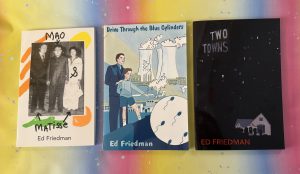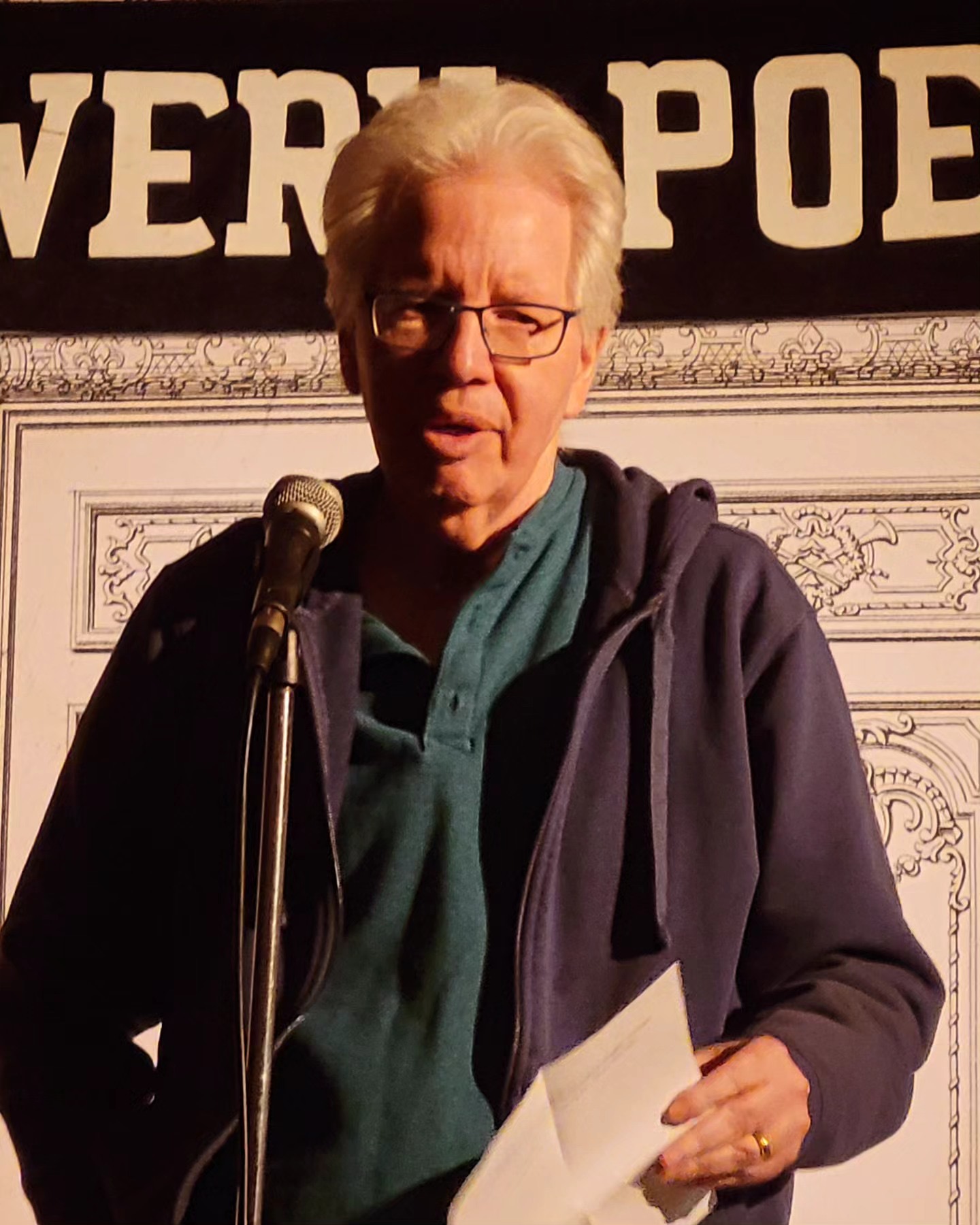

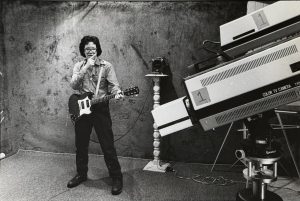
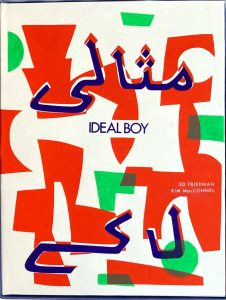
Ed Friedman grew up in 1950s Los Angeles. He made his way to New York City in the early 1970s, where he worked on magazines, collaborated with visual artists and composers, played in new music bands, and participated in the active St. Mark’s Poetry Project community. In 1987 he became the Poetry Project’s Artistic Director, a position he held until 2003. His books of poetry and prose include The Telephone Book; Humans Work; Mao & Matisse; Away (with Robert Kushner); Drive Through the Blue Cylinders; Two Towns; and Ideal Boy (with Kim MacConnel). Mao & Matisse, Drive Through the Blue Cylinders, and Two Towns were all published by Hanging Loose Press.
Hanging Loose Press: What are this past year’s accomplishments that you are most proud of?
Ed Friedman:
- Having poems of mine appear in Hurricane Review, New American Writing, Posit, Three Fold, Nu Review, Julebord, No Placebos, and Long News.
- Giving readings at Harry’s Poetry Hour, Bowery Poetry Club, Welcome to Boog City 18.5 Arts Festival, KGB, Long News Issue 1 launch.
- Co-hosting the 2024 and 2025 New York Poets series at Bowery Poetry.
HLP: Sounds like you’ve been busy! The submitting-work process can be arduous. Do you have any good strategies for making it less so?
EF: I suppose a good strategy could be to become so famous and write such terrific poems that editors beg to publish my work. But that strategy is probably more arduous and potentially deadening than just writing what I write and submitting it.
HLP: Ha, good point! Can you talk a little bit about what goes into hosting the NY Poets series? What is your curating process?
EF: I curate and host the series with Bob Rosenthal (Cleaning Up New York, Straight Around Allen, 5th Avenue Overhead), who is a longtime friend and poet-comrade. The series grew out of a workshop we convened together in 2022, sometimes referred to as Wingding. Attending the monthly workshop were/are poets whose writing we like and with whom we’ve worked and collaborated, in one way or another for decades. Largely because of the COVID pandemic, most of us hadn’t given an in-person featured reading in years, so most of the readers in the first season of NY Poets (Jan.-Mar. 2024) were Wingding participants. The rest of the readers were folks of roughly the same ages (50s-70s) and with whom we had similar kinds of relationships as those we had with the workshop attendees. This curatorial criteria was also the basis of the Winter 2025 series, though most of the readers were not Wingding members. As for curatorial process, Bob and I would have lunch, brainstorm a list of possible readers, create a schedule, and after lunch, begin inviting people. We were lucky that longtime friend/comrade Bob Holman generously offered us dates at the Bowery Poetry Club.
HLP: As curating processes go, yours seems pretty fine. Any particularly difficult experiences/challenges for you this year? And how did you work through them?
EF:
- Tearing a tendon in my left foot has been difficult. I’m working on healing it: availing myself of podiatry, physical therapy & home exercises, laser therapy, and deep tissue massage. I haven’t completed treatment, but depending on the day, I’m fairly optimistic about the outcome.
- Bearing witness to the ultra-right-wing and overt oligarchic takeover of the U.S. government, foreign policy, and economy has been troubling. I (we) will probably be “working through” this for an extended period.
HLP: Certainly, we are a nation with a difficult history, one that some want to forget or rewrite. I do find the “bearing witness” aspect to be both crucial yet excruciating! Can you talk more about the “working through” we’ll have to do?
EF: Ha ha ha. I notice that you didn’t choose to follow up on my injured tendon. That’s ok. But FYI it’s still an ongoing challenge.
In one sense “working through” refers to how we continue to do our work as poets—writing poems, reading and responding to one-another’s work, supporting literary community, publishing, etc. How we do all that will depend on how bad things get. Will writers be aggressively censored, jailed, sued, deported, etc. because of what we’ve written or the progressive efforts we support? What will happen to poets who can no longer afford medical care? What about those of us whose paid teaching jobs disappear? And how will the ongoing climate disaster (the one that right-wingers like to deny) affect our lives and literary activities?
“Working through” also pertains to what we do as a country to reclaim democratic process, rule of law, and a government that attempts to serve its population’s most basic rights and needs. Here, we’re talking about protracted coalition building, strategic actions, policy development, effective communication, restorative practices (work that keeps us functioning well), etc.
Most interesting to me is the deeper working-through necessary for our species’ recovery from centuries of the coercion, domination and oppression required for enabling exploitive societies. Well, that was quite a sentence, but what you refer to as our “difficult history” has left us with a lot of emotional damage to recover from, all of which makes it harder to come together, find common ground, resolve our differences, and create a world that truly reflects what’s humanly possible.
HLP: Glad your tendon is getting better! And now that you mention it, what you’re going through might be just the metaphor that describes what we’re undergoing now as a divided people.
HLP: What are three books you’ve read recently that have made an impression on you?
- David George Haskell’s Sounds Wild and Broken: Sonic Marvels, Evolution’s Creativity, and the Crisis of Sensory Extinction.
- Charlotte Carter’s Walking Bones, published in 2002 by Serpent’s Tail, is a noir fiction.
- Ron Padgett’s Pink Dust.
HLP: Can you offer any more description on how these books resonated?
EF: Haskell’s Sounds Wild and Broken is fascinating in its description of how sound came into being and then evolved. One assumes that there were sonic vibrations on earth just as soon as there was an atmosphere that could be stirred. Earthquakes rumbled, winds blew, water swished, etc. but there wasn’t what we refer to as sound until there were ways for it to be perceived. Haskell conjectures that the first life forms to create sound were probably bacteria, and the first creatures to both register and create sound might have been primitive relatives of the cricket. I love creation myths/stories like these. Chapters later Haskell, vividly describes all the sounds he can hear in a marsh and what the utterances made by frogs, birds, etc. communicate among prospective mating partners. His descriptions have a scientific precision and the kinds of florid detail I associate with “nature writing.” Sounds Wild and Broken is gorgeous and deeply informative, though I find myself taking frequent breaks from the overload of its richness. Is it wrong that I’ve listed a book here that I haven’t finished reading? Before I’ve even reached the part where human civilizations are destroying the planet’s sonic diversity? I promise that I’ll finish Sounds Wild and Broken, but not necessarily soon.
I’ve loved Charlotte Carter’s writing since her first books were published by Bernadette Mayer and Lewis Warsh on their United Artists imprint. Walking Bones, published in 2002, is a noir fiction, but unlike most works of that genre, it doesn’t coalesce around a crime. Instead of a criminal underworld, the novel’s main character, a black female former fashion model, is drawn into an abusive sexual obsession with a dapper white man. The coercion with which he dominates her doesn’t come in the form of violent threats, but instead plays upon frailties brought about by race, class, gender, and sexual vulnerability. Charlette’s writing is visually and emotionally vivid. There’s a materiality and truth to it. It’s witty, fast-moving and hardboiled (only not in testosterone). I haven’t talked about the male characters in the story, but they too are convincingly drawn and have their own sexual obsessions. Carter is so good that the novel’s denouement actually freaked me out for a couple of days.
Pink Dust is Ron Padgett’s most recent poetry collection. I’ve already read it a couple of times and will most likely read it again soon. Why is that? In part it’s because I enjoy the poems so much, but also they are so well-tailored, so witty, feel so much like someone is talking personally to me, that it’s easy to overlook how much is there. In other words, the more I look a Ron’s poems, the more I feel rewarded by my effort. There just aren’t that many poets whose work strikes me that way. Here are a couple of quotes from Pink Dust that I found particularly gratifying. The first is kind of a forward to the whole book.
“Every time I approach a blank page
the poems in it shout, “Oh no!
Here he comes again! Run!”
I grab at them as they flee
like terrified little bugs.
Gotcha!”
And from “One Poem or Three Poems”
When I write a poem
I have a battle with myself,
but when I finish,
it falls silent, the battle,
and moves away
like ancient Greeks
looking for another place to fight
There’s honesty, humor, and pleasure in how Ron characterizes writing poems. He acknowledges the timeless struggle to make interesting writing and then emerges victorious, looking forward to more struggles in the future. Heroic, eh?

HLP: Yes, poets (and anyone really) who can grasp that struggles begat opportunities and enllightment are truly heroes. What are your upcoming projects?
EF:
- Completing the manuscript for a new collection of poems. Finding a publisher for it. Any suggestions for a publisher?
- Deciding with Bob Rosenthal (and subsequently, Bob Holman) whether to host another New York Poets series in 2026.
- Trying to get key unpublished works of mine into print, some of which will require significant editing.
- Starting a completely new work.
- Continuing to support my wife’s and son’s artistic projects.
- Getting back to the gym post-tendon-tear.
HLP: Congrats! What’s your new collection called?
EF: Midsts, which is also the title of the first of three poem-series collected in the book. I like the title because it’s a hard word to pronounce. You have to make your mouth say it. Also, it describes something about how I live and imagine—that I’m always working among multiple circumstances and trains of thought. In addition to my own experience, I’m often collaging existing texts into the work.
HLP: Sounds intriguing, and yes, I really do have to focus on pronouncing it. Any reason why you wouldn’t want to curate a 2026 NY Poets series?
EF: As I’ve already mentioned, Bob Rosenthal and I had a particular group we wanted to program for the first seven-evening series. Our criteria for inviting people allowed us to put together a second season, but for a third go-round, we would probably have to rethink our mission. For me, personally, after programming at the Poetry Project for sixteen years, I don’t have a burning need to curate and host readings. So, if Bob and I can come up with a group of poets that we feel driven to host, then we will.
HLP: What kind of art do your wife and son engage with?
EF: Lori Landes, my wife is a painter. She closed up her studio in 1999 at the time our son, Sam, was born. Since Fall 2023, she again has her own studio. Her work reflects a strong interest in pattern and decoration and women’s lives. Lots of snazzy color. As for Sam, he’s a professional trumpet player and composer. He would describe his focus as contemporary experimental classical music. Lori and I are his devoted fans.