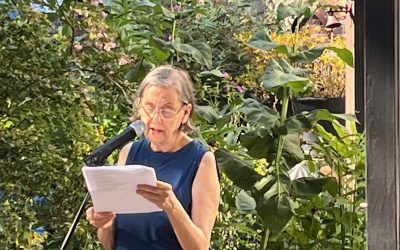
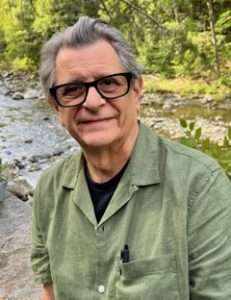
Pablo Medina was born in Havana, Cuba, and raised in New York City from the age of twelve. A celebrated poet and novelist, his work bridges both English and Spanish, exploring the nuances of language, identity, and the complexities of Cuban heritage. Medina’s debut poetry collection, Pork Rind and Cuban Songs, was the first written directly in English by a Cuban-born author, establishing him as a pioneering voice in Cuban American literature. He has since published nine more poetry collections in English, including Sea of Broken Mirrors, and two in Spanish. His memoir, Exiled Memories: A Cuban Childhood, offers an evocative reflection on his early life in Cuba, while his collaborations with Carolina Hospital, such as Everyone Will Have to Listen/Todos me van a tener que oír, showcase his ongoing commitment to translating and elevating the work of Cuban authors. Medina’s work in translation is particularly notable, with his co-translation of García Lorca’s Poet in New York receiving critical acclaim, including praise from John Ashbery, who called it “the definitive version of Lorca’s masterpiece,” and Alejo Carpentier’s The Kingdom of This World, which Ilan Stavans labeled, “an achievement of the scope of Seamus Heaney’s reimagining of Beowulf.” Most recently, he has translated the work of Cuban poet Rafael Alcides, collected in Poet in the Neighborhood: Selected Poems of Rafael Alcides. His poetry collection Points of Balance was hailed as “nothing short of linguistic mastery,” and his novel Cubop City Blues was praised by the LA Review of Books as “rich and stunning.” His most recent novel, The Cuban Comedy, was lauded by NPR for its “smart and poignant” narrative. In addition to his writing, Medina is a sought-after teacher and mentor. He has taught writing, literature, and translation at esteemed institutions such as Emerson College, George Washington University, and the University of Nevada, Las Vegas. He is currently Emeritus Professor at Emerson College, where he also served as Director of the MFA Program. His lectures and workshops have taken him to a diverse range of international venues, including the Cervantes Institutes in New York and Amman, Jordan, the Library of Congress, Universidad San Carlos in Guatemala, and the Bread Loaf Writers’ Conference. A recipient of fellowships from the Guggenheim Foundation, the National Endowment for the Arts, the Rockefeller Foundation, and others Medina’s work continues to be celebrated for its depth, linguistic artistry, and profound exploration of cultural identity. He divides his time between Williamsville, Vermont, and Cambridge, Massachusetts, and is currently on faculty at the Warren Wilson MFA Program for Writers.
Hanging Loose Press: What are this past year’s accomplishments that you are most proud of?
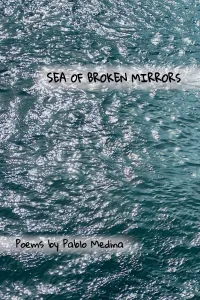
Pablo Medina: Well, first off, and most importantly, I made it through the year with little to complain about, except toward the end, when Donald Trump was reelected president. I don’t fault him, I fault those who voted for him. If the United States can survive this man’s rule, it can survive anything. I finished a draft of a long poem, my first, and published, earlier in the year, Sea of Broken Mirrors, my eleventh collection of poetry, from Hanging Loose. I also completed Poet in the Neighborhood: Selected Poems of Rafael Alcides. It’s a bilingual edition with my translations of the Cuban poet’s work, to be published in spring 2025 by Diálogos Books.
HLP: Any particularly difficult experiences/challenges for you this year? And how did you work through them?
PM: See above. We now have a president who will, if he has his way, undo the country and replace it with a toxic mix of resentment, racism, and sexism. It depresses me to think about. Obviously I am not working through this very well, yet. Writers can no longer afford to be silent and passive.
HLP: Agreed, the work of poets and writers is ever more prescient and vital. I have no doubt that you will move beyond silent and passive. Do you want to describe how you will do so?
PM: Before November 24, I hoped that the voting process would remove the obvious danger to democracy that Trump and his people posed. I was wrong. Trump was elected. All we have left in the next four years is individual action linked by a common purpose. I write, I speak, I stand against political moves that will diminish the values this country has espoused from its very beginning. My family was forced to leave a country where freedom of speech was not tolerated and dissent was punished severely. Lies and mendacity ruled (still rule) in order to keep the powerful in place at the expense of the powerless.

HLP: What are three books you’ve read recently that have made an impression on you?
PM: El espejo enterrado (The Buried Mirror) by Carlos Fuentes is a massive and masterful history of Hispanic culture from its origins in the Iberian peninsula to its spread throughout the Americas. It reads like a novel, but then, what do you expect from a great novelist?
I reread Pedro Páramo by the Mexican Juan Rulfo, and then read the new translation by Matthew Weatherford, published in 2023 by Grove Press. It is a great and complex novel, the brevity of which complements its density, and its density, in turn, compresses the narrative into something akin to poetry.
I’ve been reading Louise Glück Poems 1962 – 2020. There is much to admire in her work, and much to learn from it, though humor is lacking. I would call her work reticent confessionalism.
HLP: Pablo, I love your description of how the narrative of prose can be so condensed and compressed to become “something akin to poetry” (though even the tautest of poems can be epics).
PM: The lyric drive does have its purpose in novels, but in most it appears sporadically as an antidote to the forward rush of the narrative drive. Someone asked Borges why he hadn’t included Moby Dick in a list of important novels, and he replied, “Because it isn’t a novel. It’s a poem.” Something there is worth exploring, don’t you think?
HLP: This thing we call genre is a double edged sword: surely it is good to be able to define your work in terms that does it justice, but then if you are forced to confine your work to said genre due to society’s dictates and whims, I don’t think that serves our purpose.
PM: Since it came up in our conversation I wanted to further discuss the issue of genre. I’m of the opinion that the writer is aware at some level of the genre he or she is working in, based on what is it that propels them on the page: lyric, narrative, dramatic, rhetorical, didactic, or informational drives. If the narrative predominates, he/she writes fiction or nonfiction prose; if the lyric, the result is poetry, if dramatic, a play, and so on. That is not to say that genre is exclusive and there are plenty of examples of hybrid writing or writing that refuses to label itself so as not to be pigeonholed. However, the only genre that, almost by its very nature, will encompass all the drives, is the novel. And I say that fully conscious that memoir can do it, but when it does, it approaches the novel form in its desire to create a world that is not in existence at the time of the writing. In fact, I maintain that memoirs are novels disguised as confessions.
HLP: I maintain that memoirs are novels disguised as confessions. I may quote you on that.
Speaking of confessions, I agree that Glück gives us much to contemplate, but in terms of her humor, I think it’s just deeper below the surface than we realize. Consider from “The Egg”:
Being gone. A week’s meat
Spoiled peas
Giggled in their pods: we
Stole.
PM: I think it is a cute quote, but it lacks the resonance of humor, as is the case in most of her work. Humor is serious work. Perhaps now that you make me rethink my initial response, I should say that Glück’s work in general lacks lightness, as Italo Calvino might refer to it (as a counter to the weight of living). A poem should not be a fun machine, but neither should it take itself so seriously that it lacks balance. I still believe she is a great poet, worthy of study and reflection.
HLP: Any upcoming projects?
PM: I am working on a book-length narrative poem in English and a complementary one in Spanish. I just finished Poet in the Neighborhood: Selected Poems of Rafael Alcides, which is due to be published later this year by Diálogos Press.
HLP: We look forward to it!
Order Sea of Broken Mirrors here